


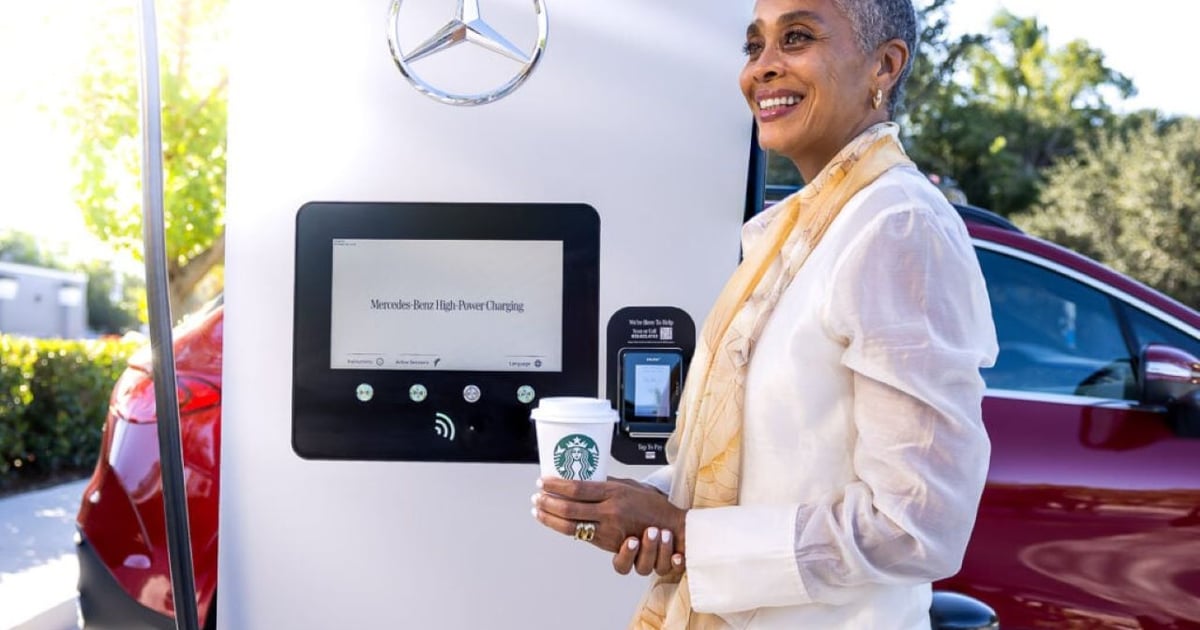
Starbucks and Mercedes-Benz High-Power Charging have opened their first collaborative EV charging station in Red Bluff, California.
This marks the beginning of a partnership to electrify over 100 Starbucks locations along the critical Interstate 5 corridor.
The 400kW DC fast charging EV hub is the first deployment in a network expansion that will span the 1,400-mile West Coast travel route from Canada to Mexico.
Red Bluff charging hub is positioned along Interstate 5 to serve the traffic corridor connecting major West Coast metropolitan areas. The station offers charging speeds up to 400kW. Mercedes-Benz High-Power Charging is designed to serve all EV brands, not exclusively Mercedes-Benz vehicles.
The Interstate 5 corridor represents a critical testing ground for EV infrastructure deployment, connecting major population centres from Seattle to San Diego.
The route’s heavy commercial and recreational traffic makes it an ideal location for demonstrating how retail partnerships can accelerate the expansion of charging networks.
This development comes as Mercedes-Benz continues to expand its EV technology portfolio, including recent vehicle-to-grid (V2G) ready EV lines that can integrate with future smart charging systems.
However, the automaker has faced challenges in the US market, including paused deliveries of certain electric models due to significant profit declines, highlighting the importance of infrastructure partnerships for maintaining a market presence.
The Starbucks partnership positions Mercedes-Benz High-Power Charging to compete with other major charging network initiatives along California’s corridors. The state has seen significant infrastructure investment, including IONNA’s US$250 million Rechargery concept with 1,000 charging bays and municipal programmes, such as Los Angeles selecting It’s Electric to deploy 90 new public chargers.
The companies plan to announce additional Interstate 5 locations throughout 2025, with the network expansion targeting high-traffic Starbucks stores positioned for optimal highway access.
Each station will feature multiple 400kW charging stalls, designed to minimise wait times during peak travel periods.
The partnership represents a broader trend toward destination charging infrastructure, where established consumer brands leverage their real estate footprint to accelerate EV adoption.
link