Edge AI emerges as cyber force multiplier, enhancing operations and safeguarding critical installations from evolving threats
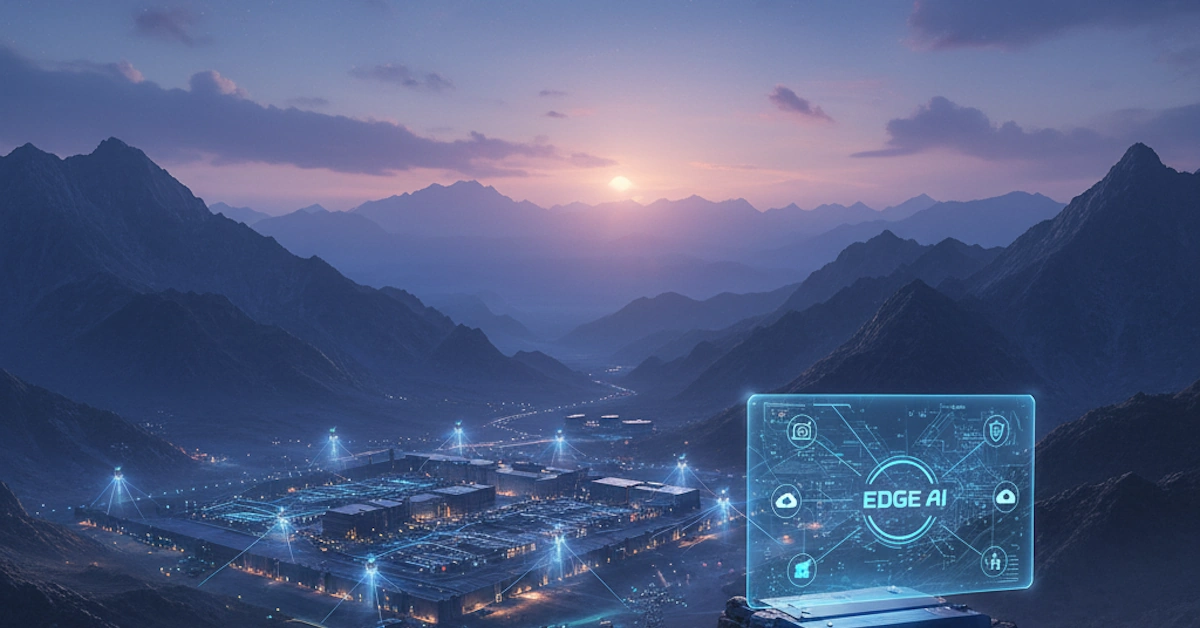
Edge AI can bolster frontline units and protect critical infrastructure, while its potential applications extend well beyond the cases studied. On the battlefield, edge AI enables forward units to process signals rapidly and sustain operations even when communications are jammed or severed. It also allows autonomous teams, such as drone swarms, to coordinate maneuvers independently of distant servers. In critical infrastructure, edge AI improves the efficiency of power grids and water systems while providing safeguards that keep them operational even if central networks are compromised by cyberattacks.
Jacob Wentz, a former research intern at the Strategic Technologies Program at the Center for Strategic & International Studies (CSIS), noted that in both military and civilian contexts, the technology strengthens resilience by moving decision-making closer to the edge. He argued that to ensure edge AI becomes a durable strategic asset, the U.S. must establish clearer deployment frameworks, particularly within the defense sector. These frameworks must also confront the ethical and accountability challenges inherent in autonomous warfighting.
“The vulnerabilities that soldiers face on contested networks are parallel to issues facing domestic systems,” Wentz wrote. “The networks underpinning the U.S.’s critical infrastructure are prime targets for cyber disruption. In 2024, U.S. officials revealed that the Chinese state-sponsored group Volt Typhoon had infiltrated utilities, water systems, and transportation networks, maintaining long-term access as preparation for sabotage.”
Critical infrastructure is vulnerable because its operational systems are not uniformly sealed. Many facilities run on local, closed networks, but growing demands for remote monitoring, vendor maintenance, and cloud oversight have eroded that isolation. These external links improve efficiency, but also create points of exposure. Attackers often begin in information technology networks that handle business functions such as email, where phishing and credential theft are easier. From there, they pivot into the OT (operational technology) systems that control physical processes at the critical infrastructure plants. Once inside these environments, adversaries ‘live off the land,’ using legitimate administrative tools to persist and spread.
Wentz noted that cybersecurity experts have advocated for the use of digital twins to harden U.S. infrastructure. “A digital twin is a virtual replica of a physical system, such as a power grid or water plant, that mirrors its behavior using live sensor data. These models establish baselines for normal operations, making anomalies easier to spot. They also allow operators to simulate cyberattacks and cascading failures, exposing the weak points whose protection would prevent the greatest disruption.”
Edge AI can complement this approach by preprocessing the flood of sensor data that feeds the twin. Local intelligence ensures the model reflects conditions on the ground without overwhelming bandwidth or storage, while the twin provides the broader picture for anticipating and preparing for attacks. Moreover, edge AI can strengthen resilience by giving facilities the ability to act locally when networks are cut or compromised.
“By running inference directly on-site, facilities can make certain safety decisions without relying on central servers or cloud connections,” according to Wentz. “A substation controller could trigger a protective shutdown, or a water-plant sensor array could adjust valves to stabilize pressure, even if external networks are compromised. This local autonomy is not without risks, but in a crisis, the ability for field devices to function as independent islands is a critical safeguard. It ensures that essential services can continue or shut down safely, even when adversaries have infiltrated wider networks.”
Edge deployments are already emerging in energy and water systems. Energy utilities are using edge devices to manage distributed energy resources such as solar panels and batteries, running optimization locally rather than sending every decision back to the cloud. That speed is crucial for grid management, where balancing supply and demand requires near-instant responses to shifting loads and intermittent renewable generation.
In the water sector, operators have begun adding edge controllers that process sensor data on site, monitoring flow, pressure, or water quality and flagging anomalies more quickly than central systems alone. Catching those irregularities in real time can prevent small faults from compounding into service outages or contamination events. These early deployments are driven by efficiency, but they also show how edge AI can catch faults close to the source and reduce reliance on vulnerable networks.
Wentz recognized that, as with battlefield systems, “the goal should not be to abandon centralized networks, but to build a hybrid model. Edge AI adds a resilience layer, ensuring that when adversaries strike, core infrastructure can still function at a minimum level, protect itself from cascading failures, and recover more quickly.”
Edge AI could shape national security in countless other ways that will bring parallel risks, including expanding the attack surface, complicating oversight, and creating new tensions between centralized and decentralized systems.
Wentz observed that some U.S. agencies have started to recognize this. Cybersecurity and Infrastructure Security Agency (CISA), for instance, has outlined how AI deployment intersects with critical infrastructure security. “But its ability to carry out that mission is already under strain: recent workforce cuts have driven out nearly a third of the agency’s staff, undermining the very capacity needed to enforce resilience plans.”
Meanwhile, he notes that mainstream AI policy debates remain fixated on scaling frontier models, with far less attention to deployment. “If the United States wants to secure a technological advantage, it must not only build more advanced models but also craft clear policies for how and where they are applied. That also means ensuring that the institutions tasked with defending critical systems have the resources to execute their mandates.”
The edge is where resilience will be built, and where restraint will need to be enforced. Neglecting it would mean implementing AI into the national security apparatus on fragile foundations.

link