How a hackathon is making IT greener
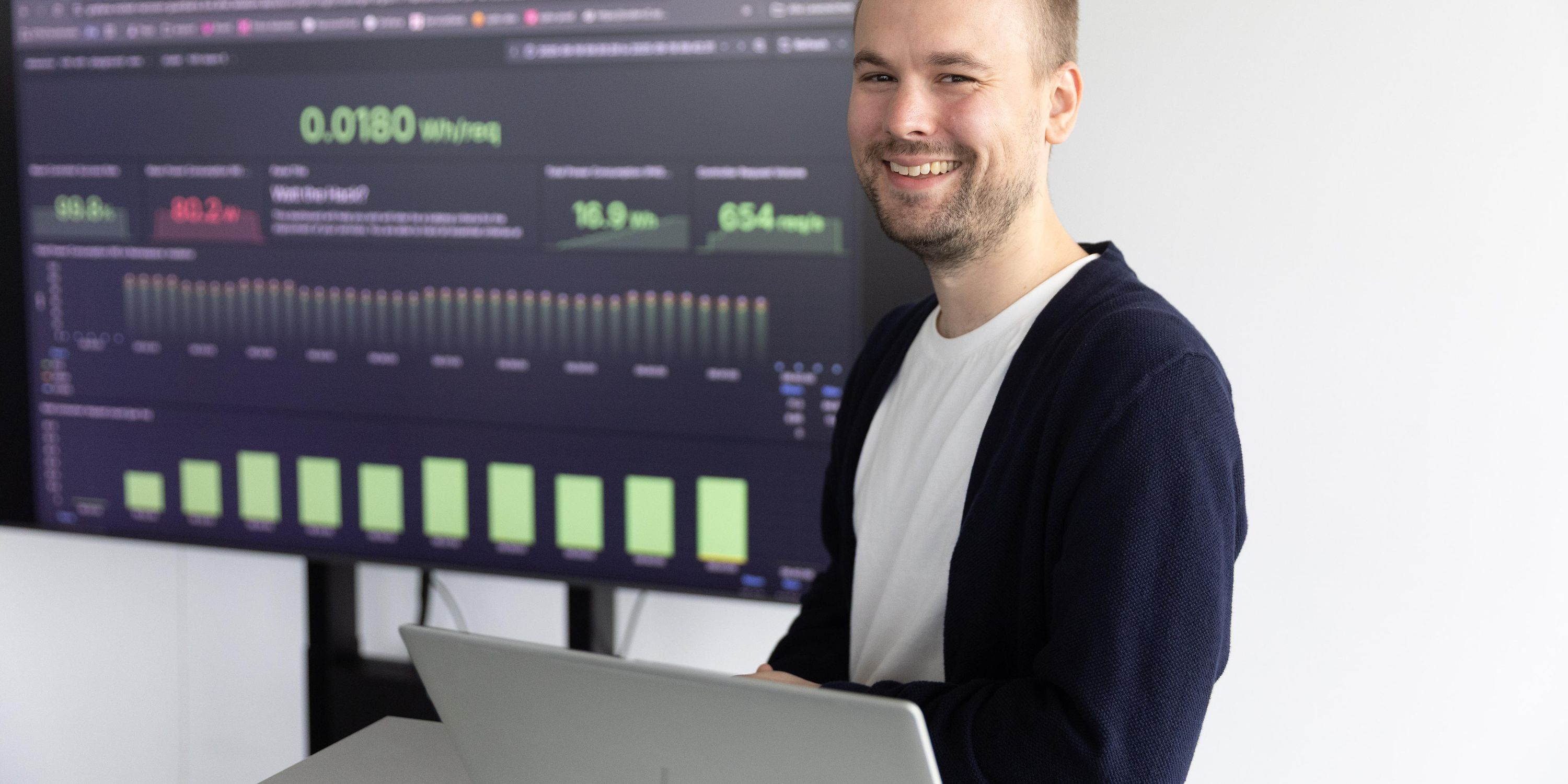
Heads were spinning, computers were glowing. 130 colleagues spent 48 hours coding AI solutions for Telekom. They lived up to the name “hackathon”: ‘thon’ for marathon and “hack” for technical trick. Nicolas Wellmann was there. Here he describes his impressions. He also reports on what it means to turn an idea into an application for many after a hackathon. He experienced this himself.
Hackathons are programming competitions on a specific topic. You have participated in several of them. This time, you supervised a challenge at “Hack4Humans AI.” How was it?
Nicolas Wellmann: It’s incredible what our colleagues have achieved in such a short time. Many of them coded late into the night, and it was wonderful to see how they work with AI. What’s more, it was clear how much they care about human-centered AI, which was the theme of the hackathon. Many of them took on challenges that were completely new to them and worked great as a team. The winning teams then presented their solutions to the Management. There were already signs that this is just the beginning.
In what way, for example?
Nicolas: Our “Watt the Hack” challenge focused on efficient software platforms – we now want to work with DT Technik and T-Systems to see how we can test the winning prototype in a Deutsche Telekom project. Our technology department is now continuing to work on the AI solution for mobile phone base stations.
Let’s keep our fingers crossed for everyone! You yourself have taken part in several Deutsche Telekom hackathons, and one of them must have stuck in your memory.
Nicolas: Yes, definitely. The one in 2023 on sustainability in IT, or “green coding.” In short, that means programming software efficiently to use less electricity and produce less CO2. We developed a tool there that makes it possible to test the energy consumption of software. I like to compare it to a thermometer. It allows you to examine how changing a piece of software affects its energy consumption.
That was the birth of “Green Coding” – there was an interview about it at the time. Your solution has been implemented in Deutsche Telekom IT. What helped you bring it from the hackathon into the company? The founding of our internal “Green Code Community” together with my colleague Falko Finzel, to exchange ideas with others about sustainable IT, was also useful.
Nicolas: It was helpful that, after the hackathon, I was able to present Green Coding to a larger group, including a member of the executive board,– just as the current winning teams have done. Founding the Green Code Community together with my colleague Falko Finzel to exchange ideas about sustainable IT with others was also useful. Another important factor was the close and productive collaboration with our colleagues from our central development platform, who will officially take over the operation of our solution in the future. This was a huge endorsement of our team’s work. But let’s not kid ourselves: it was the right topic at the right time. Our company and its products are increasingly being measured by how much electricity they consume and how much CO2 they produce – including in IT.
What tips would you give to others who want to see their hackathon prototypes grow?
Nicolas: Nicolas: From my own experience, I can say that you need to be patient and build close relationships with others within the company. You need a network of people from a wide range of disciplines. And like-minded people who are just as enthusiastic about your idea as you are.
When the “green coding idea” gained momentum, what did that mean for you?
Nicolas: At first, we thought it was just about developing a software solution that measures the power consumption of software code. But today, I can say that our topic is much bigger than what we once developed at the hackathon and what we imagined. The issue of sustainability must be considered from the outset when making IT decisions. We need more transparency about the CO2 emissions of entire IT applications. For development, we need the tools and closer knowledge sharing to develop applications more efficiently. And how can we actually meet our climate targets when the use of energy-intensive AI is currently ubiquitous?
Sounds like a tough nut to crack …
Nicolas: To better address this issue, we are now officially part of the Group Corporate Responsibility division of our IT department, headed by Amir Kangalou. Together with a team, I work there as a program lead to develop solutions for IT that make IT’s CO2 emissions visible and reduce it. Incidentally, this topic is not only important in the context of sustainability—it often helps to reduce costs at Deutsche Telekom as well.
What’s next?
Nicolas: Two exciting innovations, still this year. First, CO2 labels. These are display fields where developers can always see how much CO2 their entire software projects generate in the cloud. Such data is collected automatically by cloud providers. But in everyday development, it is cumbersome to call up and read it. We have a solution that makes it easier to respond and reduce consumption. Second: so-called ARM processors. Cloud providers advertise their high energy efficiency, but using them requires a few adjustments to the software. We have already gained experience in this area and built a prototype that is being tested with various teams. Together with the team of our central development platform, we want to make this prototype available for building, testing, and rolling out software. This will allow development teams to check the extent to which their software is suitable for operation with ARM processors, thereby saving costs and CO2. True to the motto – trying is better than studying.😉
Dr. Nicolas Wellmann …
… originally a competition economist, combines over ten years of experience in research and practice in the analysis of big data and AI models. He currently specializes in resource-efficient programming of software and AI models and is Program Lead Corporate Responsibility DTIT. Nicolas is co-author of Deutsche Telekom’s Green-AI-Principles, the Bitkom guide “Resource Efficiency in the Software Lifecycle” and co-founder of the Green Code Community. He is also involved in a Deutsche Telekom internal talent program, where he works with talented individuals to develop innovative software solutions for sustainability in IT.
“Hack4Humans AI”Around 130 employees competed in a programming contest at the international event in Bonn. The focus was on AI solutions for various topics (“challenges”). After two days, the jury selected three winning teams: One impressed with its solution for a T-Buddy, a digital companion designed to offer young people online help. Another team was honored for its machine learning solution that monitors the quality of mobile phone stations. And: One team’s solution promises around 30 percent energy savings in programming by making AI software platforms work more efficiently.
link