Will AI Agents Upend The Software Development Life Cycle?

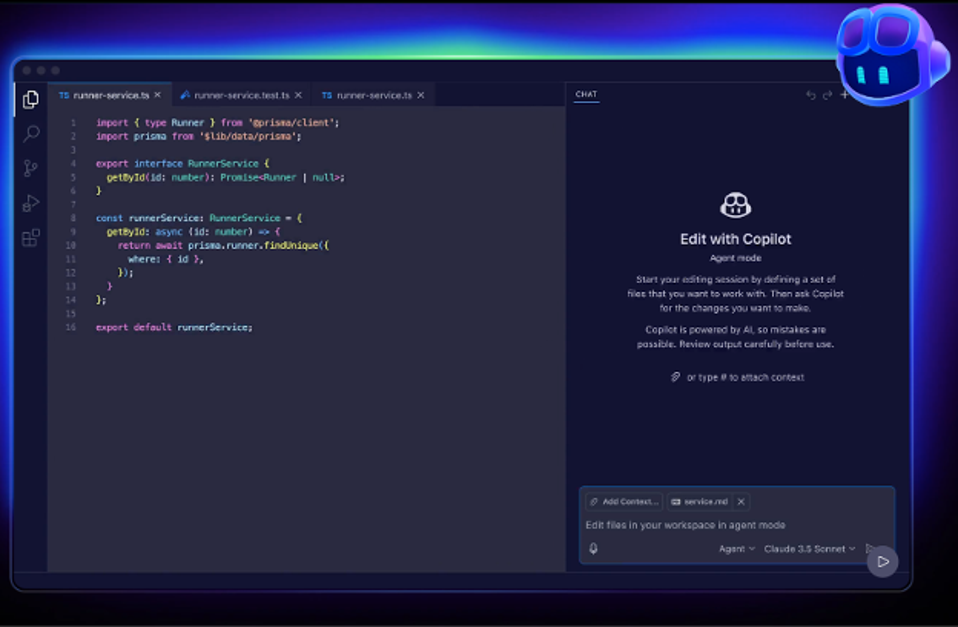
Engaging Agent Mode on active code in GitHub
May 2025 will go down in history as the month when agentic software development was truly unleashed upon the world. A significant step up from chat-based code assistants, agentic software tools have been positioned as a revolutionary change in the software development life cycle. Announcements from Microsoft (GitHub Copilot Agent Mode), Google (Jules), OpenAI (Codex) and Anthropic (Claude Agents) are all very promising. However, my conclusion is that we are not witnessing a revolution, but are simply seeing a further evolution of AI automation. And to be honest, I think that is good news.
What Makes Agentic Development Different?
First, let’s discuss what has driven this leap forward from coding assistants. A coding assistant is essentially a bot interface to a large language model, and this mechanism has been quite beneficial to many developers. As one proof point for this, at its Build conference in May, Microsoft said that the GitHub Copilot assistant has been used by 15 million developers. (Note: Microsoft is a client of my firm, Moor Insights & Strategy.)
But three fundamental AI shifts have led to the creation of these new agentic development tools, which significantly expand the AI benefit to developers.
- Reasoning models — The introduction of more powerful reasoning models provides developers with AI that spends more time gathering data and processing it to provide richer and more contextual responses. A developer can now ask an LLM to design the entire application — not just a single file — and receive a well-thought-out multi-page, multi-component plan. The reasoning model is also better equipped to handle iteration with the developer, who will want to tune and change the initial design.
- Massive context windows — In addition to reasoning models, the amount of context that can be included in a prompt is now quite large. So instead of being limited to asking relatively simple questions, you can now load multiple documents (such as requirements documents or user stories) into a prompt, which then enables the reasoning model to get a better feel for what’s required of the new application. Additionally, new standards such as MCP enable easier integration between those data sources and the agent.
- Agentic workflows — While the first two innovations provide a better AI experience, the ability for agents to share data and be assembled into workflows is the big game-changer. Now, instead of single tasks that need to be enacted by the developer at every step, agentic workflows can have complex multi-step tasks delegated to them. This allows a developer to ask an agent to do something while the developer moves on to another task. And this is good, since the reasoning models and increased context mean that some of these tasks will run for a while (minutes, in many cases). This ability for developers to delegate many tasks and supervise them in parallel is being positioned as a major productivity boost.
Digging Into Microsoft’s SDLC Vision
At the Build conference, Agent Mode in GitHub Copilot was the cornerstone of Microsoft’s vision of a new SDLC. The company’s demonstrations of how much more quickly work can be completed and the seamless integration between VSCode and GitHub were quite impressive — and were always likely to get the lion’s share of media coverage. But what’s most impressive is the overall breadth of Microsoft’s announcements and the fact that Microsoft may be the only company able to execute such a vision. Here are three non-Copilot things from Microsoft that also improve the SDLC.
- The Azure SRE agent (in preview) — Whether the application is created by a person or an AI, there will of course be challenges at times after deployment. To address this, the SRE agent is built to constantly monitor performance, security and application health. It can take action on its own or report issues to the right resources.
- Many ways to incorporate context — In addition to MCP, I also appreciated that Microsoft enabled some basic capabilities to help inject context into the development process. For example, coding standards can be loaded into an instruct file for all agents to use. Additionally, adding contextual information to an agent can be as simple as adding an attachment to a model in much the same way as with an email. These are little features that will feel familiar to a developer and should help improve the overall experience.
- Researcher and Facilitator agents (in preview) — It’s been said many times, but the developer’s job is not just about coding. And while I am typically skeptical about off-the-shelf agents, Microsoft introduced a couple at Build that were quite intriguing. The Researcher agent is custom-designed to help someone complete research activities. For developers, I can see this agent as a tool for testing product-market fit or to perform competitive intelligence. The Facilitator agent is similar to what we have seen in other collaboration tools like Zoom, where an agent is taking notes and collecting action items. Through its integration with Teams and other tools, the Facilitator can set follow-up meetings or assign action items on the fly. Both of these should help speed along non-development processes that are part of (or should be part of) every developer’s weekly tasks.
What’s Still Missing
I applaud Microsoft for creating innovations across the whole SDLC. And I know that there are other improvements in security and software updates that I did not include. I do believe that Microsoft is likely the only company that can execute a broad vision for the SDLC since it owns some of the biggest pieces (tooling, repositories, security, collaboration) that a developer needs. That said, I’d like to offer up a couple of areas where Microsoft could look next.
- High-scale testing — When we see demos of AI developer tools, the testing is generally limited to unit testing, test case creation and code reviews. I think that a high-scale testing solution — where we can see real high-scale integration and performance testing happen — would be a major benefit to enterprises.
- Work pattern research — I had some great conversations with the GitHub and Microsoft Research teams on how tooling like this changes the work patterns and responsibilities for developers. Those discussions were illuminating, and Microsoft’s recent Work Trend Index (also covered by my colleague Melody Brue) suggests a desire to figure this out. But a more granular set of SDLC-specific research to dig into developers’ work patterns would be great.
Massive Evolution Isn’t A Revolution
I walked away from Build impressed with the technology Microsoft has available and also what is in preview. A great deal of my research over the past 12 months has been around the impact and possibilities of AI agents and agentic workflows. However, I also am not sure we have seen something revolutionary in the SDLC — at least not yet. To me, revolutionary means that it changes the game and how it’s played. Evolutionary is introducing new efficiencies to the existing game, which is what I see happening so far in this space. Here are a couple of examples of what I mean.
- Revolutionary — The agile movement in software development upended decades-long practices and sped up software delivery. It created new roles, changed responsibilities of existing roles and led to new management metrics and practices that were widely adopted across many different kinds of organizations.
- Evolutionary — Global outsourcing leveraged technology and took advantage of a global talent pool to reduce development costs and improve scale and efficiency, often leading to sped-up software delivery. (Note, however, that often the increased speed emerged because the outsourcing firms had also adopted agile.)
So far, agent-based tools are more like the outsourcing trend — but that’s not necessarily bad. AI is still very new and moving very fast. Revolutionizing everything would likely overwhelm many enterprises, so embracing new tools to do existing work may just be the first step in what could ultimately be a revolutionary movement.
Moor Insights & Strategy provides or has provided paid services to technology companies, like all tech industry research and analyst firms. These services include research, analysis, advising, consulting, benchmarking, acquisition matchmaking and video and speaking sponsorships. Of the companies mentioned in this article, Moor Insights & Strategy currently has (or has had) a paid business relationship with Google and Microsoft.
link